
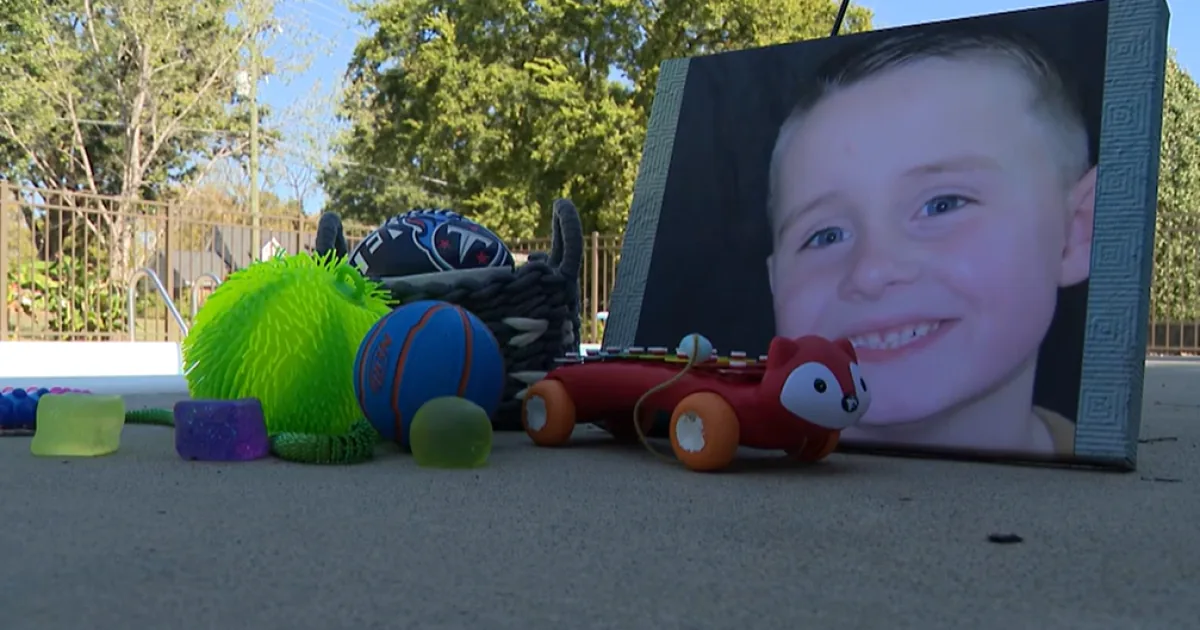
HENDERSONVILLE, TN — A Sumner County mother is speaking publicly after her nonverbal son with autism, Waylon Wilder, died when he wandered away from the family yard and was found in a neighbor’s swimming pool. Haley Wilder says the loss happened in moments and has left her determined to push for greater awareness of autism, stronger support for children with disabilities and safer community spaces.
Thousands of people received alerts during the search for the missing child before responders found him and tried to save his life. Now Haley Wilder is focusing on how her son lived, describing a boy who loved water, the trampoline, sensory toys and the Tennessee Titans. She says she wants people to understand both the danger her son did not recognize and the joy he brought to the people around him.
How Waylon Wilder disappeared from the family yard
Haley Wilder said she was outside with her children when Waylon slipped out of sight. She recalled pushing him on a hammock, glancing at her daughters and looking back to find him gone. In her telling, the moment passed so quickly that there was little time to react before he had wandered away.
Although the pool was secured, Haley said Waylon did not understand that it could be dangerous. She said he had no fear and no sense of risk, which is part of what made the tragedy so devastating. Her account underscores how quickly an ordinary backyard moment turned into a fatal emergency.
The boy was later found in a neighbor’s swimming pool, and efforts were made to revive him. Officials and responders have not publicly detailed every step of the search in this story, but the warning about the missing child reached thousands of people before the rescue attempt.
A mother wants Waylon remembered for his personality
Haley Wilder says she does not want her son remembered only for the way he died. She describes Waylon as free-spirited, gentle and deeply loving, a child who communicated in ways other than speech. Though he was nonverbal, she said he expressed himself through smiles, his eyes and affection for the people close to him.
She also shared the things that made him happy: water, jumping, sensory play and cheering for the Titans. Those details, she said, are part of the fuller picture of who he was. To her, he was “light” and “love,” a child who made a lasting impression on family members and anyone who knew him.
Haley’s message is aimed at helping others see children with autism as individuals with distinct personalities and needs. She says the public conversation should not stop at the circumstances of his death, but should include the warmth and joy he brought to daily life.
School plans were still on her desk when he died
Before Waylon’s death, Haley Wilder had been working on plans for him to return to school. She said paperwork for an individualized education program was on her desk when the tragedy happened. In her words, she moved from filling out school forms to filling out a death certificate in what felt like a blink.
She said she had been trying to find a school that could meet his needs, but ran into barriers along the way. According to Haley, one school did not have the level of support he required, and she was told she would receive a callback about other options. That call never came, she said, and she eventually decided to homeschool him.
Her comments point to a wider challenge many families face when looking for educational settings equipped to serve children with disabilities. For Haley, the issue is personal, but she says it also reflects a system that can leave parents struggling to find appropriate support.
Calls for better training and funding in local systems
In the days after Waylon’s death, Haley Wilder said she is still advocating for children with disabilities and for a more inclusive community. She says better training is needed across local systems, including in schools and among law enforcement, so that they are better prepared to respond to children with autism and other special needs.
She also pointed to funding as part of the problem. In her view, school systems need more resources to provide the kind of support some students require, and responders need the tools and preparation to handle situations involving vulnerable children. Her comments reflect a belief that awareness alone is not enough without practical changes.
Haley said she hopes Waylon’s story leads to safer spaces for children who may not recognize danger the way others do. She wants people who already understand autism to continue learning, and she wants those who do not to become more aware of how differently children can experience the world.
A family message that keeps Waylon's legacy moving forward
Haley Wilder shared a longer message about her son, saying he was sweet, happy and deeply loved by his family. In that message, she said his life touched people in ways she may never fully know and that his memory will continue to shape the way she speaks about inclusion, love and community.
She wrote that her goal has always been to build a more inclusive world for children like Waylon and that she intends to continue that mission in his honor. For her, that means carrying his love into every conversation and every effort she makes to improve understanding for families navigating disability and autism.
Waylon’s legacy, as his mother sees it, is not only in grief but in the changes she hopes his story can inspire. She said he will always be remembered as a beautiful boy whose presence left a mark that cannot be replaced.
