
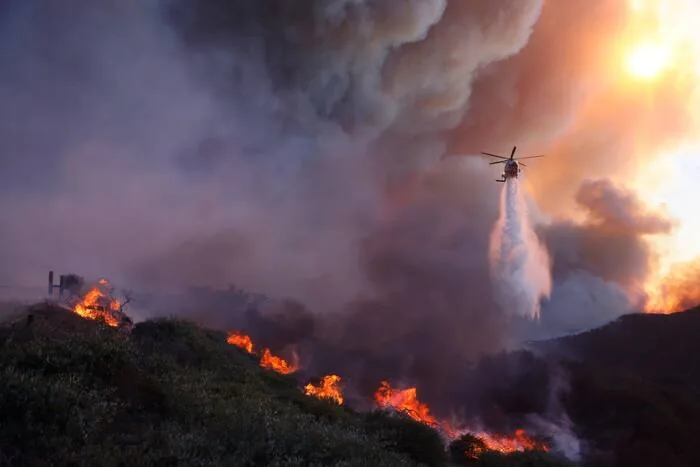
LOS ANGELES, CA — A federal jury has convicted Jonathan Rinderknecht of setting the fire that prosecutors say led to the deadly Palisades Fire, one of the most destructive wildfires in California history. The verdict came Friday after his first federal trial ended in a mistrial earlier this year.
Jurors found the 30-year-old guilty on charges of destruction of property by means of fire and arson. Prosecutors said he lit a fire on Jan. 1, 2025, that smoldered underground in root systems before flaring up again on Jan. 7 and racing through neighborhoods in Los Angeles and Malibu.
The wildfire killed 12 people and destroyed large sections of both communities. Rinderknecht showed little reaction as the verdict was read and later hugged his lawyers before leaving the courtroom.
How prosecutors connected the January blaze to the Palisades Fire
Prosecutors argued that the Jan. 1 blaze, known as the Lachman Fire, never truly went out. Instead, they said, it remained hidden underground until conditions allowed it to erupt again six days later as the Palisades Fire.
At trial, the government presented digital forensic evidence, fire-detection camera images and expert testimony to narrow the window of ignition. Investigators also told jurors they ruled out other possible ignition sources, including fireworks.
The case centered on proving that Rinderknecht’s actions on New Year’s Day set in motion the later inferno. Prosecutors said the evidence showed the second fire was a holdover from the first one, making both charges part of the same chain of events.
Evidence from phones, cameras and travel patterns shaped the government case
Assistant U.S. Attorney Mark Williams said the second trial was built more tightly than the first. Jurors heard about photographs that showed Rinderknecht’s car parked near the base of a trail leading toward the fire’s origin area, along with cellphone tower data tracking his movement on the hill.
Prosecutors also pointed to his behavior in the hours before the fire. Uber passengers and text messages sent to his girlfriend, they said, showed he was angry and unsettled. Williams told jurors that Rinderknecht was “mad at everything, and frustrated.”
After the fire started, prosecutors said, he called 911 more than a dozen times while walking downhill and screen-recorded part of the calls on his phone. They also said he asked ChatGPT whether someone could be at fault if a fire was lit because of their cigarettes, describing that as part of an effort to build an alibi.
The first trial ended with a deadlocked jury and a new indictment
This verdict followed a difficult earlier proceeding. In June, Rinderknecht’s first jury deadlocked 10 to 2 in favor of acquittal after a two-week trial, ending in a mistrial.
Prosecutors then moved forward with a new indictment for the retrial and dropped a third charge of timber set afire. Bill Essayli, the top federal prosecutor in Los Angeles, said he believed the first jury had improperly considered information that was not presented as evidence.
After Friday’s verdict, Essayli called the result a testament to the work his office put into the case. He said he was familiar with the strength of the evidence and pleased with the jury’s decision to convict Rinderknecht on both counts.
A juror said Rinderknecht’s testimony helped seal the guilty verdict
One juror who identified himself only as Cameron said he was the lone holdout when deliberations began. By the end, he said, he had concluded that the evidence pointed to guilt.
Cameron said he initially had concerns about a technical review from a defense expert who disputed the government’s fire-origin analysis. But he said Rinderknecht’s own testimony became the strongest evidence against him, especially his claims about being on the hill without smelling smoke, seeing fireworks or encountering anyone else that night.
“It took a lot for me to be convinced otherwise,” Cameron said. “After listening to every single point, I do now agree that he’s guilty.”
Defense says the fire origin was never proved beyond doubt
Defense attorney Steve Haney argued the government had not conclusively proved where the fire began. He said the site was publicly accessible before the Palisades Fire erupted on Jan. 7, leaving open the possibility that the scene had been disturbed.
The defense called its own experts, including a retired U.S. Forest Service fire investigator who said the origin area was different from the one identified by prosecutors. Haney also told jurors to focus on the act itself rather than Rinderknecht’s angry messages and other character evidence.
He offered fireworks as an alternate explanation, citing witnesses who said they heard a loud bang or explosion near the hill. Prosecutors countered that thousands of images from cameras in the area did not show fireworks above the hill where the fire began.
Sentencing is set for 2027 as mandatory prison terms loom
Rinderknecht is scheduled to be sentenced on March 17, 2027. Each count carries a mandatory minimum sentence of five years and a maximum of 20 years in federal prison.
After the verdict, Haney said the defense was disappointed but respected the jury process. He said the legal team would review appeal options at the appropriate time.
The conviction closes one major chapter in a case that drew intense attention because of the scale of the wildfire and the loss of life tied to it. For prosecutors, the verdict validated a months-long effort to connect a small January fire to the disaster that followed in one of Southern California’s most heavily damaged neighborhoods.
