
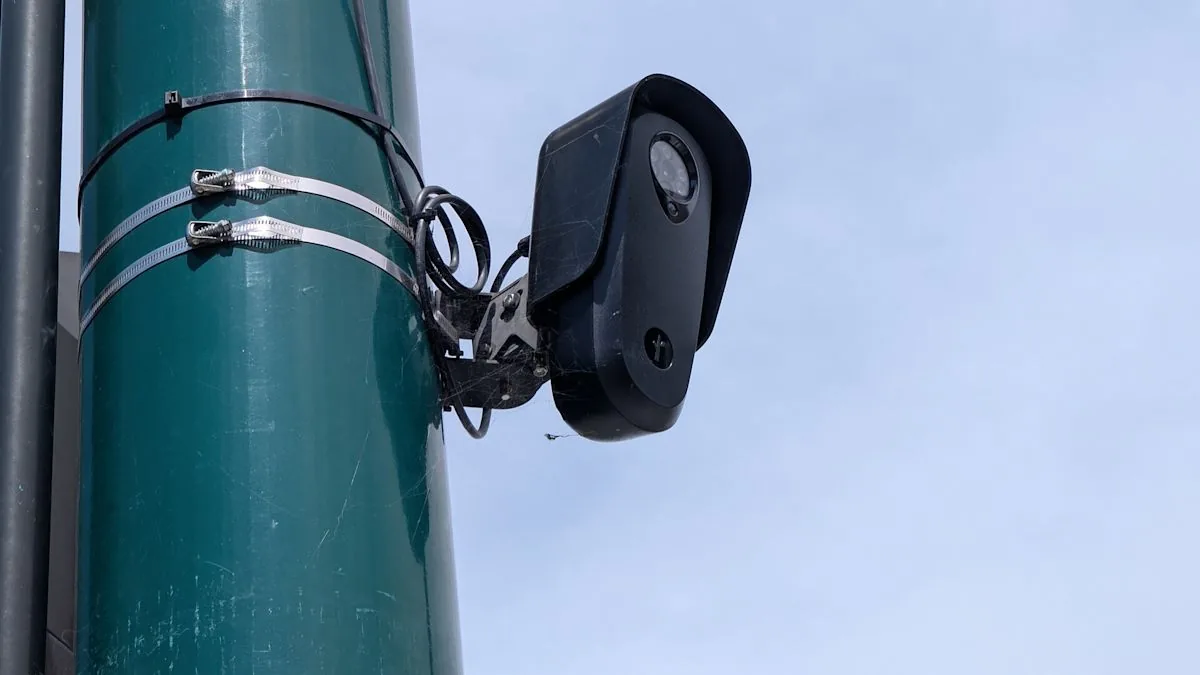
LOUISVILLE, OH — Police in Louisville, Ohio, say a 27-year-old man used a power saw to cut down three of the city’s eight Flock license plate cameras over two nights this summer, triggering nine felony counts across two cases. One camera was reportedly taken down on Aug. 22, and two more were damaged on Sept. 21.
Complaints were filed Nov. 18 in Canton Municipal Court, according to the court’s online docket. The case now includes charges of disrupting public services, possessing criminal tools, vandalism and misdemeanor trespass. Police say the cameras were part of a system the department uses to help identify vehicles and solve crimes, and the city is replacing the damaged units.
Court filings turn the damaged cameras into multiple felony charges
The filings divide the case into two felony matters, each carrying three counts of disrupting public services, one count of possessing criminal tools and one count of vandalism. Two misdemeanor cases add three trespassing counts. Police arrested the man on a warrant Nov. 19 and booked him into the Stark County Jail before he was released later that day on a $2,500 unsecured bond.
At his arraignment Monday, Magistrate Derek C. McClowry set bond at his own recognizance with pretrial supervision. The docket does not list a defense attorney. The allegations have not been proven in court, and the complaints are only the starting point in the criminal process.
Police say the cameras were cut down at three separate locations
According to reporting cited from the Canton Repository and the police complaint, the cameras were located at Metzger Park, in the 800 block of North Nickelplate Avenue, and at California Avenue and West Reno Drive. Police accuse the man of trespassing on private property at the last two sites.
Police Chief Rachel Carosello said the devices are useful for public safety and for clearing crime. She also said the suspect did not cooperate when questioned and credited Detective Zachary Clark with the investigation. WHBC reported there has been no public explanation of how Clark identified him, and the city says the cameras that were taken down are being replaced.
The lead felony hinges on Ohio’s disrupting public services law
The most serious count in the case is not vandalism, but disrupting public services, a fourth-degree felony under Ohio law. The statute applies when someone knowingly damages property in a way that substantially impairs law enforcement, firefighters, rescue personnel or emergency medical services from responding to an emergency or protecting people and property from serious harm.
Ohio’s high court has interpreted that law broadly. In a 2009 case, the Ohio Supreme Court said damaging even a single private phone during a 911 call could qualify if it substantially impaired responders. That precedent gives prosecutors room to argue that Louisville’s plate readers are more than passive recordkeeping tools because they can alert officers in real time when a listed vehicle enters the city.
The vandalism counts suggest each camera caused at least a thousand dollars in loss
The vandalism charges carry a different calculation. Under Ohio law, damaging government-owned or controlled property becomes a felony when the loss reaches at least $1,000, and it remains a fifth-degree felony until the loss reaches $7,500. By filing three fifth-degree vandalism counts, police are signaling that each camera likely fell somewhere within that range.
The court records and council minutes do not give the exact dollar figure for each camera. The criminal-tools count is tied to the saw itself, with prosecutors alleging it was possessed with intent to commit a felony. On paper, the possible penalties can include prison time, but Ohio’s sentencing rules often favor community control for many lower-level felony convictions.
Louisville kept the plate readers after banning traffic ticket cameras
The cameras became a topic of public discussion during Louisville City Council meetings in September. At a Sept. 8 meeting, Detective Clark presented a PowerPoint on the system, and Chief Carosello spoke in support of it. Council minutes say police described safeguards such as multifactor login, a case number and a stated reason for each search, plus daily audits and officer confirmation before a stop.
Police said the system had helped clear about 75 cases since the cameras were installed three years earlier. On Sept. 21, council agreed to post the department’s Flock policy on the city website, and that same night police say two more cameras were cut down. Later that fall, council approved an ordinance banning photo traffic devices that issue speeding tickets, while keeping the plate readers in place for investigative use.
Other Ohio cities have seen similar attacks on Flock systems
Louisville is not the only Ohio community to deal with damage to automated license plate readers this year. In Akron, police say 17 of the city’s 145 Flock cameras have been damaged or stolen since July. Cleveland 19 reported that three people in their 20s were arrested Oct. 22 on felony vandalism warrants in connection with some of those cases.
Other cities have reported similar incidents, including Toledo and Hubbard. In other states, authorities have said camera outages helped lead them to suspects after nearby surveillance, license plate data or network alerts pointed investigators toward the damage. Louisville’s case now moves toward another status conference in Canton Municipal Court, where a judge will decide whether it stays in municipal court or proceeds to Stark County Common Pleas Court.
