
MIDDLETOWN, IA — The U.S. Army detonated nearly five tons of degraded lead azide Wednesday at the Iowa Army Ammunition Plant in Middletown, setting off a plume of smoke and raising fresh questions about where toxic lead dust may travel next.
The blast came after three postponements and a court fight that ended Monday, when a federal appeals court allowed the detonation to move ahead. Army officials say the operation was the safest option available, but scientists say key uncertainties remain, especially how much lead entered the air and where it will settle.
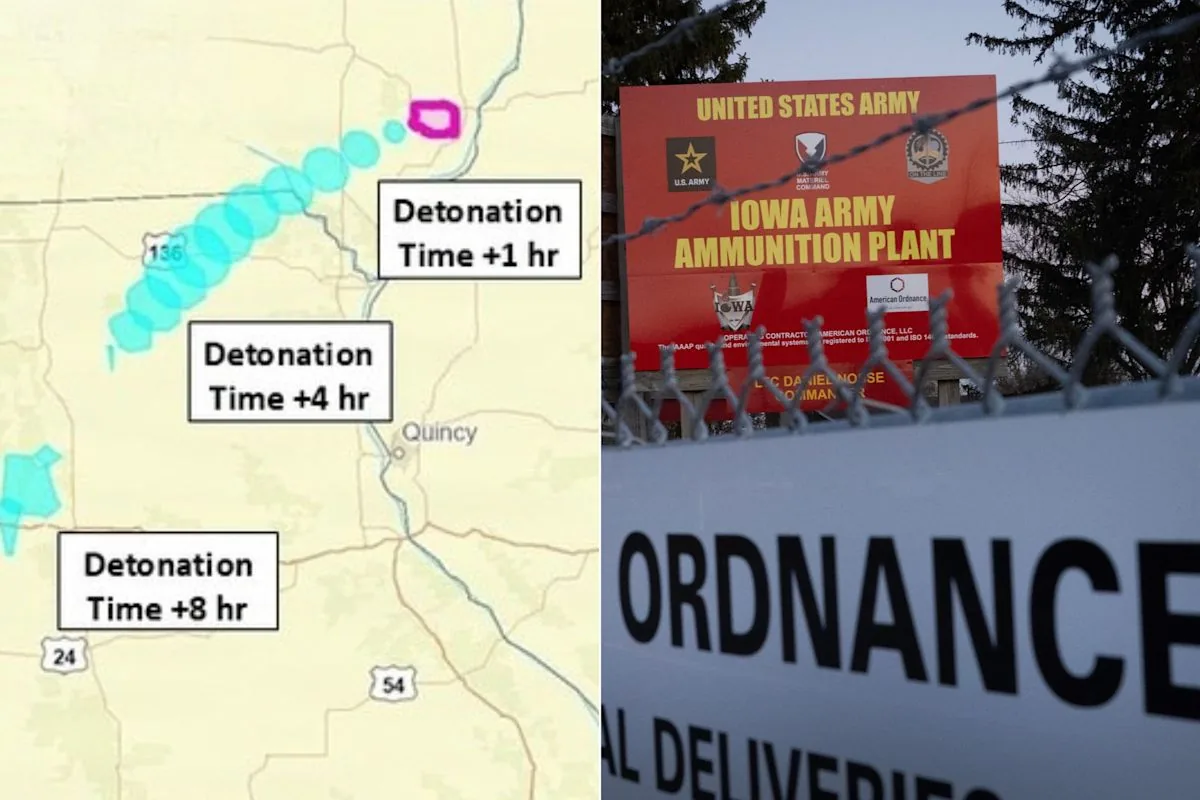
The Army also released a map showing the likely drift path of airborne dust, which it expects to move southwest from the plant and into Missouri over roughly eight hours.
Court fight and delays kept the blast on hold for days
The planned detonation had originally been set for Nov. 20, but it was delayed amid legal challenges and public concern. Environmental groups sued to stop the blast, arguing that the risks were too high.
On Monday, a federal appeals court cleared the way for the Army to proceed. The military then moved ahead with the controlled detonation on Wednesday, using a process officials said was necessary because the lead azide had partially crystallized and was too unstable to move safely.
In a Tuesday advisory, the Army said colder weather also increased the danger that the material could detonate on its own. Officials said that risk left them with a narrow set of options, even as concerns continued to grow around the plant and in nearby communities.
Army map shows plume moving southwest into northern Missouri
The Army’s forecast places the dust plume drifting southwest from the installation, with markers at one, four and eight hours after the blast. By eight hours, the map shows lead dust north of Columbia, Missouri, which lines up with the Army’s projection that particles could travel nearly 100 miles.
The graphic was described as a mitigated forecast, meaning it assumed the explosion would happen inside a bunker with extra dust-control measures in place. Even so, the map does not show how much lead is in the plume or how much of it may settle on the ground.
That limited detail is part of what has worried scientists and regulators. The Illinois Environmental Protection Agency warned Tuesday that the detonation is expected to create a dust plume containing lead particles that may travel beyond the installation and settle on surrounding surfaces.
Residents were told to stay inside while relocations were recommended
The Army said FEMA supported recommended relocations for all Middletown residents and nearby areas starting Tuesday. The advisory marked a five-mile cone southwest of the plant as the recommended evacuation zone, although no mandatory evacuations were in place as of Tuesday.
An emergency alert sent to cellphones told people within 20 miles to stay indoors with windows closed. That guidance reflected the uncertainty surrounding the blast and the possibility that lead dust could spread beyond the immediate site.
Acting Army Secretary Adam Telle said in a statement that a controlled detonation “was the option that posed the lowest risk to the public.” Sean Kaufman of the Department of Health and Human Services said pregnant women, children and people with chronic disease “definitely want to be out of that area.”
Scientists say the biggest unknowns are exposure and deposition
Experts have repeatedly said the central question is not just whether lead will be released, but how much and where it will land. David Cwiertny, director of the University of Iowa’s Center for Health Effects of Environmental Contamination, said several key factors remain unknown, including the amount emitted and the amount deposited.
Lead is a toxic metal, and the Centers for Disease Control and Prevention says no amount of exposure is safe. Nico Perdrial, a University of Vermont geochemist, said all forms of lead are harmful and warned that the detonation could increase the risk of chronic exposure.
Cwiertny said the air should dissipate relatively quickly, but he and colleagues are monitoring levels themselves after what he called an unclear monitoring response. Army, EPA and University of Iowa readings are expected to help show how much lead actually lands in the surrounding area.
Soil, water and wildlife could all be affected over time
Lead does not break down, which is why scientists are watching for long-term contamination in soil and water. Perdrial said the material is expected to end up in the soil, while Daniel Hummer of Southern Illinois University said rain or snow could help it settle faster and wash into rivers and lakes over days and weeks.
The Army’s environmental assessment says an accidental explosion would have posed a danger to nearby oak and hickory woodland that serves as habitat for endangered bats. For the planned blast, fire crews were staged outside the safety zone to respond to any grass fires before they could reach the trees.
The assessment describes the wildlife impact as minor and short-term, mostly noise that startled nearby animals. It also says removing contaminated soil at the site will reduce exposure through the food chain, including for birds such as bald eagles, which Iowa State University Extension says are especially vulnerable to lead.
Neighboring states are watching testing and cleanup results closely
The Army said it used sand-filled barriers about two stories high, a water wall, gel blocks and foam barriers to reduce the amount of lead moving through the air. It said soil, air and water near the site were being extensively tested before and after the detonation.
Officials said lab results should be published in three to five weeks. The EPA said it would sample the air before and after the blast, and the Army said monitoring would show how much lead has landed and where it ended up.
Missouri and Illinois are also tracking the situation. Missouri Gov. Mike Kehoe said the state’s Emergency Operations Center was activated, while Illinois Gov. JB Pritzker said state agencies remained on alert as the plume was expected to drift beyond the installation.
