
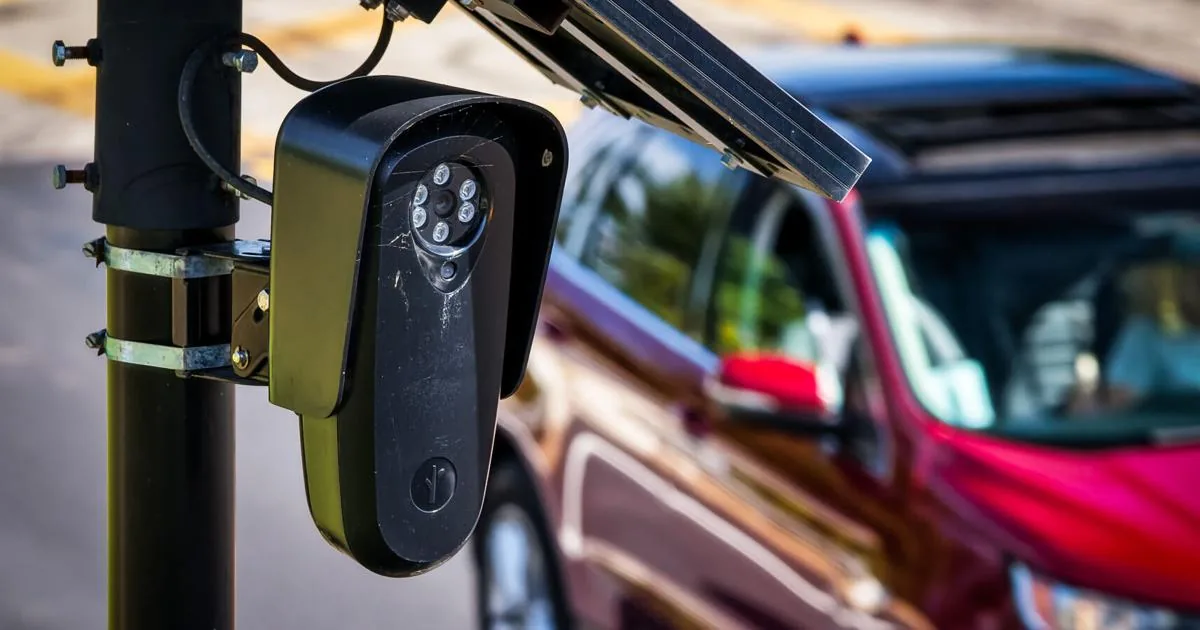
DAYTON, OH — Backlash against Flock automated license plate readers in Ohio has moved beyond criticism and into criminal damage, with police agencies reporting cameras that were moved, removed, chopped down, struck and even covered with spray paint and bags.
Search audit records and other documents obtained by the Dayton Daily News show more than 30 Ohio police agencies conducted Flock network searches over the summer in connection with damaged or missing cameras. The incidents have spread across several counties and have included vandalism, theft and property damage to devices used by law enforcement.
Critics describe ALPRs as police surveillance tools that collect too much information about too many people. Supporters say the cameras provide crucial leads in serious cases and help officers when other evidence is limited.
Agencies across Ohio logged searches tied to damaged camera networks
The Flock network records show a pattern of summer investigations involving cameras that were not simply offline, but deliberately tampered with. Some were cut down from poles. Others were rammed by vehicles, dismantled or hidden from view with paint or bags.
The Dayton Daily News reviewed audit logs and related records from police agencies in Ohio that searched the shared Flock system while looking into those incidents. The logs covered July and August and documented which outside agencies accessed the Montgomery County Sheriff’s Office database of license plate images, along with the stated reasons for the searches.
Police activity tied to the damage was not limited to one region. Investigations reached agencies in southwest Ohio and beyond, reflecting how widely the cameras are used and how broadly damage to them can affect police work.
Springboro and Franklin Twp. cases highlight the local damage
One incident occurred on Aug. 23, when Springboro police responded after someone damaged a Flock ALPR camera at the entrance to Hazel Woods Park on West Lower Springboro Road near the Springboro and Franklin border. A service report listed the case as criminal damaging.
Police officials said they could not discuss the case further because it remains under active investigation. Two days later, a Warren County Sheriff’s deputy responded to the 5800 block of Dixie Highway in Franklin Twp. after a Flock camera was cut down, according to a criminal offense report.
That camera belonged to the state of Ohio and was valued at $3,000, the report said. The deputy photographed the scene and recovered the camera along with its solar panel, but investigators found no additional physical evidence. The sheriff’s office said the device cost about $800 to repair.
Union Twp. investigation led to a suspect before charges were dismissed
In Union Twp., east of Cincinnati, a mid-June incident caused more than $1,000 in damage after someone removed bolts from a pole and took down a Flock camera, a solar panel and a computer box, according to a complaint filed in Clermont County Municipal Court.
Police said they identified a suspect, a 35-year-old Cincinnati man, by reviewing video from a nearby privately owned surveillance camera and linking him to a credit card purchase and rewards account. The complaint said officers were seeking felony vandalism and theft charges.
Those charges were dismissed in mid-August. The case still stands out as one of the clearer examples in Ohio of how investigators are using a combination of camera footage, purchase records and digital traces to trace suspects in attacks on surveillance equipment.
More summer incidents reached Butler, Clark and Montgomery counties
The Union Twp. case was followed by another one on July 31, when someone cut down a pole holding two ALPR cameras in Hanover Twp., northwest of Hamilton in Butler County. That incident happened one day after police arrested the suspect in the Union Twp. case.
Other agencies also reported similar problems over the summer. Beavercreek police and the Clark County Sheriff’s Office investigated vandalized Flock cameras, while Liberty Twp. police searched for information related to stolen devices. The Ohio State Highway Patrol also helped the Vandalia Police Department with an ALPR vandalism investigation.
Elsewhere in the state, cameras were reportedly struck by cars, knocked down, spray-painted and covered. In Toledo, several Flock cameras were recently vandalized, including some covered in paint. Records and news reports also show that police in Ohio and other states have investigated cases where cameras were hit by gunfire or struck by objects.
Supporters say the cameras solve crimes, while critics warn of surveillance
Flock says its network includes more than 120,000 cameras across 49 states and that damaging public safety equipment is illegal. A company spokesperson said criminal acts should never be part of any protest or complaint, adding that harming the cameras ultimately hurts the communities they are meant to protect.
The company also says it works with police agencies to investigate damage, preserve evidence and restore service quickly. Flock argues that when a camera goes offline, investigators can lose a lead that might have helped in an AMBER Alert, a missing-person case or a violent crime investigation.
Flock says its cameras help law enforcement clear about one in five cases in communities where the technology is deployed. Police supporters say the devices can provide evidence in serious cases where otherwise there may be few leads.
Privacy concerns continue to drive resistance to ALPRs
Case Western Reserve University professor Michael Benza said the backlash could stem from several different motives, including frustration over privacy concerns, anger that government has not taken objections seriously, or simple opportunity to destroy property. He said he cannot know why any one person acted, but the pattern likely reflects broader unease with the technology.
Benza said plate readers differ from ordinary traffic cameras because they track vehicles and movements over wide areas and record information about everyone on the road, not just suspected criminals. He said some people object to the idea that their travels can be documented over time and space.
He also noted that police have sometimes misused plate readers in personal spying situations, which can deepen distrust. As a result, even as law enforcement touts the crime-solving value of ALPRs, Ohio agencies are now dealing with a separate problem: deliberate attacks on the cameras themselves.
